Check out this SlideShare Presentation:
Showing posts with label Apache. Show all posts
Showing posts with label Apache. Show all posts
Sunday, August 8, 2010

Thursday, March 18, 2010
TraceWatch
![[Screenshot]](http://www.tracewatch.com/contents/index_images/screenshot_overall.jpg) TraceWatch Real Time Web Stats and Traffic Analysis Lets you keep track of the visitors to your website in real time with detailed statistics and deep analysis using an innovative user interface for FREE and helps you make your website more effective. Can be easily installed on any website supporting PHP and MySQL. You only need to upload some files to your server.
TraceWatch Real Time Web Stats and Traffic Analysis Lets you keep track of the visitors to your website in real time with detailed statistics and deep analysis using an innovative user interface for FREE and helps you make your website more effective. Can be easily installed on any website supporting PHP and MySQL. You only need to upload some files to your server.http://www.tracewatch.com/
Sunday, January 24, 2010
20+ .htaccess Hacks Every Web Developer Should Know About
Apache's .htaccess(hypertext access) configuration file can be a very powerful tool in a web developer's toolkit if used properly. It can be found in the webroot of your server and can be easily edited using any text editor. In this article I'm going to show you 20 .htaccess hacks and how to use them.
Before I start with this article I'd like to start by saying that abusing the .htaccess file will hurt the performance of your website. The .htaccess file should only be used if you have no other way to achieve certain things.
http://devmoose.com/coding/20-htaccess-hacks-every-web-developer-should-know-about
Wednesday, March 4, 2009
Setting up a production rails server step-by-step
Pushing your app to the real world with Rails can be a very daunting task to someone who is used to just uploading flat html or php files.
If you’ve never dealt with Apache, mod_rewrite, or proxy servers, prepare to spend a lot of time hammering out a solution. Worried about performance, or your need to scale out at a later date? Pick a solution that won’t leave you wondering if your site will be able to take a spike in traffic.
For Rails, there are lots of deployment strategies, some are tuned for compatibility with shared hosting (fastcgi), and some are built for speed and minimum configuration (Litespeed Nginx and Lighttpd), and some are built to leverage the strength and flexibility of stable and established server software (Apache+Mongrel).
If you want to scale, you’re going to need a load balancing proxy. The choices here are pound, pen, and apache’s mod_proxy_balancer.
An abundance of choice is a double-edged sword. Competition is good in any arena, but it makes it very hard for someone who hasn’t tried them all to choose one.
I’ve chosen to setup my Rails server using the Apache+Mongrel+mod_proxy_balancer combination.
For the operating system, I’ve chosen the newest Ubuntu 7.10 (Gusty) server. Ubuntu uses the Debian-style apt package management, but with more current packages than Debian stable, and is the current cool kid on the block for Linux systems. I have been using Ubuntu for years and can attest to its stability and cutting edge (but not bleeding edge) packages.
I’ve gone through and built a Rails server by hand before, but poorly documenting what I had done, and not securing it properly. When I stumbled upon Slicehost’s server setup articles, I knew I had found exactly what I needed to build a server configured like a pro, and all the documentation I should have written in the first place.
Here is the step-by-step setup for a production Rails server. I’ve tested this setup and can vouch for its awesomeness. I encourage you to make some changes specific to your setup where appropriate. You should be able to skip unneccesary stuff like php and virtual hosts if you don’t need them.
- Ubunty Setup - part 1
- Ubunty Setup - part 2
- Myql and Rails
- Apache and PHP
- Apache Virtual Hosts
- Vhosts and permissions
- Apache Vhosts, Rails and Mongrels
- Mongrel Clustering
- Subversion intro
- Setting up svnserve
- Securing svnserve with ssh
- Setting up Capistrano
- Setting up Piston to manage plugins
As you can see, most of these are from Slicehost’s documentation articles. They also detail setup for several other major linux distributions and other deployment strategies like nginx. Major props to slicehost for putting such excellent documentation together.
Wednesday, December 31, 2008
Woopra.com
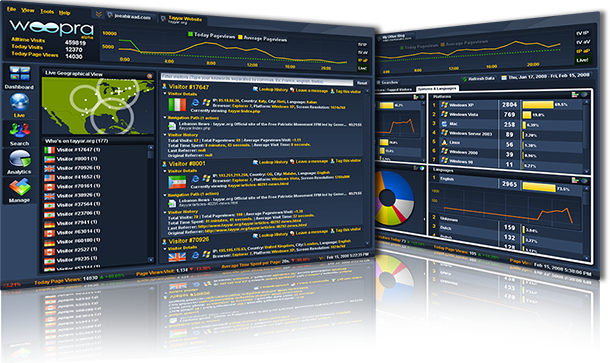
What is Woopra?
Woopra is the world's most comprehensive, information rich, easy to use, real-time Web tracking and analysis application. And it's free! Learn more...
Woopra’s revolutionary server architecture, combined with its intuitively designed client software, enables seamless tracking of visitors. Webmasters can track over 40 different statistical events and analytics. Never before has so much information been instantaneously available to Webmasters. Most analytical and site statistics are updated once a day at the least, or several times during the day. With Woopra, you get live track of visitors coming and going and moving through your site. You get the stats now.
Monday, November 10, 2008
Using mod_concat to Speed Up Start Render Times
The most critical part of a page’s load time is the time before rendering starts. During this time, users may be tempted to bail, or try a different search result. For this reason, it is critical to optimize the head of your HTML to maximum performance, as nothing will be visible until it finishes loading the objects inside.
One easy way to speed up rendering during this crucial time is to combine your CSS and JavaScript, saving the performance tax associated with every outbound request. While easy in theory, in practice this can be difficult, especially for large organizations.
http://www.artzstudio.com/2008/08/using-modconcat-to-speed-up-render-start/
Sunday, November 9, 2008
The CouchDB Project
Apache CouchDB is a distributed, fault-tolerant and schema-free document-oriented database accessible via a RESTful HTTP/JSON API. Among other features, it provides robust, incremental replication with bi-directional conflict detection and resolution, and is queryable and indexable using a table-oriented view engine with JavaScript acting as the default view definition language.
Apache CouchDB is an effort undergoing incubation at The Apache Software Foundation (ASF), sponsored by the Apache Incubator PMC. Incubation is required of all newly accepted projects until a further review indicates that the infrastructure, communications, and decision making process have stabilized in a manner consistent with other successful ASF projects. While incubation status is not necessarily a reflection of the completeness or stability of the code, it does indicate that the project has yet to be fully endorsed by the ASF.
http://incubator.apache.org/couchdb/index.html
Apache CouchDB is an effort undergoing incubation at The Apache Software Foundation (ASF), sponsored by the Apache Incubator PMC. Incubation is required of all newly accepted projects until a further review indicates that the infrastructure, communications, and decision making process have stabilized in a manner consistent with other successful ASF projects. While incubation status is not necessarily a reflection of the completeness or stability of the code, it does indicate that the project has yet to be fully endorsed by the ASF.
http://incubator.apache.org/couchdb/index.html
Monday, October 6, 2008
glTail.rb - Realtime logfile visualization
View real-time data and statistics from any logfile on any server with SSH, in an intuitive and entertaining way.
Features:
Features:
- Real-Time
- Multiple logfiles on multiple servers
- Configurable layout
- Multiple logfile parsers (Apache Combined, Rails, IIS, Postfix/spamd/clamd, Nginx, Squid, PostgreSQL, PureFTPD, MySQL, TShark, qmail/vmpop3d)
- Custom events
- Show rate, total or average
- If you can 'tail' it, you can visualize it
- Written in Ruby using net-ssh & ruby-opengl
- Free! (GPLv2)
Sunday, October 5, 2008
Logstalgia: Web server access log visualizer
Logstalgia (aka ApachePong) replays or streams a standard website access log (eg access.log) as a retro arcade game-like simulation.
Requirements
The display is rendered using OpenGL and requires a 3D accelerated video card to run.
An example access log is included.
Requirements
The display is rendered using OpenGL and requires a 3D accelerated video card to run.
An example access log is included.
Example Command Lines
logstalgia /var/log/apache/access.log
Watch a log file from in a window, using the default groups.
tail -f /var/log/apache/access.log | logstalgia -
ssh user@yourserver.com tail -f /var/log/apache/access.log | logstalgia -g "Ad Clicks,/adclick.php,30" -http://code.google.com/p/logstalgia/
Subscribe to:
Posts (Atom)